A continuación otro de los TED-ED interesantes que os recomiendo. Se trata de Why is the Milky Way flat? o ¿Por qué es plana la Vía Láctea?:
TED-Ed: Why is the Milky Way flat? - Scott Hershberger
Explore the ever-evolving structure of the Milky Way galaxy, and find out how it got its spiral shape.
--
Thirteen billion years ago, the gas and dust particles that eventually became our Milky Way were whizzing around in every direction. Despite the wild motion of its parts, the galaxy as a whole was rotating about an axis. So why did the Milky Way, like most galaxies, become flat, and not spherical like stars and planets? Scott Hershberger explores the ever-evolving structure of our galaxy.
Lesson by Scott Hershberger, directed by Josh O'Caoimh, Mikai Geronimo.
Mostrando entradas con la etiqueta steam. Mostrar todas las entradas
Mostrando entradas con la etiqueta steam. Mostrar todas las entradas
domingo, octubre 06, 2024
martes, mayo 28, 2024
The Surprising Truth About Inspiration - La sorprendete verdad sobre la inspiración (by John Spencer)
En este post os muestro un vídeo de 2 minutos y medio sobre The Surprising Truth About Inspiration - La sorprendete verdad sobre la inspiración (by John Spencer):
The Surprising Truth About Inspiration - La sorprendete verdad sobre la inspiración (by John Spencer)
The Surprising Truth About Inspiration - La sorprendete verdad sobre la inspiración (by John Spencer)
I used to think inspiration came spontaneously from within. When you feel inspired, you immediately jump to creative work.
But as I’ve moved through my creative journey, I’ve noticed that it’s much more complicated.
Here’s how I thought inspiration worked. And here’s how it actually worked.
Over the last decade, I’ve gotten to interview makers – whether they are chefs or artists, engineers, architects, or writers – and I’ve seen that inspiration is all around us. It is deeply contextual.
Inspiration happens when you engage in a community of fellow makers. You borrow ideas and share strategies and even offer critical feedback to one another. Inspiration happens you stay curious and geek out on concepts and information and approaches to your craft.
Here, you curate your favorite ideas or creative works and eventually you mash-up ideas and processes until you have something original. Sometimes inspiration happens when you play and goof off. But sometimes it happens when you rest and go on walks or visit spend time in nature or even get really bored.
In these moments of rest, your mind makes connections between seemingly unrelated ideas and you are inspired to think outside the box.
Inspiration can happen when you see a problem you care deeply about or when you build empathy with a group and work toward creating solutions in a way that is horizontal and democratic.
Inspiration happens when you experiment and learn from mistakes. And it can actually grow stronger when you face that toxic fear that prevents you from finding your creative voice and taking creative risks.
Inspiration is your big “why” that sets the course for all of your creative work. It exists even when you don’t feel inspired. Sometimes you just have to get started and you’ll rediscover it.
lunes, mayo 20, 2024
Empowering Students to Own the Assessment Process - Empoderar a estudiantes para que hagan su evaluación
En el post de hoy os muestro a continuación un vídeo de 4 minutos en el que John Spencer nos explica la importancia de empoderar a los estudiantes para que hagan su propia evaluación.
Empowering Students to Own the Assessment Process - Empoderar a estudiantes para que hagan su evaluación
Empowering Students to Own the Assessment Process (by John Spencer)
Here's a sketch video about self-assessment and peer assessment. It includes an explanation of specific strategies you might use.
Transcript:
Assessment is all around us. If you’re a skater at a skatepark, you’re engaging in self-assessment every time you reflect on your progress and plan next steps.
If you’re a runner training for a marathon, you look at time splits and compare it to your goals. If you’re a musician, you’re engaging in assessment every time you listen to yourself play
and make modifications on your approach.
As an author, you engage in self-assessment when you revise your work. It’s not always individual. Often, assessment happens in community. If you’re a chef, you’re engaging in peer assessment when you ask a trusted fellow chef, “how does this taste?”
If you’re an artist you might ask for an extra set of eyes on a particular project. If you’re an engineer, you might observe users to see if your design is working. If you do any kind of creative work, both self-assessment and peer assessment are vital for improving your craft.
It helps you refine your process and helps you improve your products.
Assessment helps us figure how what we know, what we don’t know, and what steps we need to take in the future to master a skill or understand a concept at a deeper level.
But what does this mean in the classroom?
It starts with self-assessment. Here students engage in goal-setting: where they set goals, plan their approach, and keep track of the progress. They also engage in self-reflections. Here, they can reflect on their learning process but also focus on the strengths and weaknesses of their products, which then leads to new iterations.
A similar option is a student survey with multiple choices, checkboxes, and Likert scales. In some cases, students might use a self-assessment rubric. Students are able to look at the progression from emerging to mastering with specific descriptions in various categories. They are able to gain an accurate view of how they are doing, while also having a clear picture of where they need to be.
Students might also use checklists. These can be a powerful diagnostic tool that students use before, during, and after a task. When projects are done, they can present their work in a portfolio, where they reflect on what they’ve learned.
Peer assessment is also important. One option is the 10-minute peer feedback system. This begins with one student sharing their work or pitching an idea while the other student actively listens.
It then moves into a chance to ask clarifying questions, get feedback, respond to feedback, and chart out next steps. Another option is structured Feedback with Sentence Stems. Or you could use the 3-2-1 Structure. This is simple. Students provide three strengths, two areas of improvement and one question that they have.
Or you could do a feedback carousel. Each group gets a stack of sticky notes and offers anonymous feedback as they move from group to group. Or you could keep it more open-ended with Peer Coaching: Students interview each other about the process, guide reflection, and provide feedback.
We often think of classroom assessment as a conversation between teachers and students. But in life, students won’t always have a teacher to grade their work or provide them with necessary feedback. This is why we need self-assessment and peer assessment. The more we can integrate this into our lessons, the better prepared our students will be for the creative life.
Empowering Students to Own the Assessment Process - Empoderar a estudiantes para que hagan su evaluación
Empowering Students to Own the Assessment Process (by John Spencer)
martes, abril 23, 2024
We Need a Bigger Definition of Creativity (by John Spencer)
Hoy os muestro a continuación un vídeo de John Spencer que trata de explica que necesitamos una más grande definición o marco que comprenda la palabra CREATIVIDAD - CREATIVITY en toda su magnitud e importancia para nuestra sociedad.
We Need a Bigger Definition of Creativity (by John Spencer)
We Need a Bigger Definition of Creativity (by John Spencer)
When you the word “creative,” you might think of a painter or a playwright or an author or a photographer or a filmmaker or a chef. In other words, you might think of people who make things.
I think it’s what we mean when we use a label like “creative type.” But there is no such thing as a creative type. We are all creative. Every one of us. We just need a bigger definition of creativity.
Yes, creativity involves making things. But it can also mean mashing up ideas in innovative ways. It can mean geeking out on data and finding unique solutions to practical problems. It can mean hacking systems and tweaking things in unusual ways. It can mean exploring ideas and navigating information until you become an expert curator.
It can mean designing systems that empower the creative work of others. It can mean creating change in the world by speaking truth and leading movements and interacting with people.
See, each of these creative approaches shape our world in profound ways.
And the more we see the creativity all around us, the more we are able to appreciate the creativity inside of ourselves.
domingo, septiembre 03, 2023
¿Cómo la Inteligencia Artificial puede salvar (no destruir) la educación? - How AI Could Save (not destroy) Education by Sal Khan #educacion #education #SalKhan #IA #AI
¿Cómo la Inteligencia Artificial puede salvar (no destruir) la educación? - How AI Could Save (not destroy) Education by Sal Khan
How AI Could Save (Not Destroy) Education | Sal Khan | TED
Sal Khan, the founder and CEO of Khan Academy, thinks artificial intelligence could spark the greatest positive transformation education has ever seen. He shares the opportunities he sees for students and educators to collaborate with AI tools -- including the potential of a personal AI tutor for every student and an AI teaching assistant for every teacher -- and demos some exciting new features for their educational chatbot, Khanmigo.
If you love watching TED Talks like this one, become a TED Member to support our mission of spreading ideas: https://ted.com/membership
Follow TED!
Twitter: https://twitter.com/TEDTalks
Instagram: https://www.instagram.com/ted
Facebook: https://facebook.com/TED
LinkedIn: https://www.linkedin.com/company/ted-...
TikTok: https://www.tiktok.com/@tedtoks
The TED Talks channel features talks, performances and original series from the world's leading thinkers and doers. Subscribe to our channel for videos on Technology, Entertainment and Design — plus science, business, global issues, the arts and more. Visit https://TED.com to get our entire library of TED Talks, transcripts, translations, personalized talk recommendations and more.
Watch more: https://go.ted.com/salkhan
 • How AI Could Save...
TED's videos may be used for non-commercial purposes under a Creative Commons License, Attribution–Non Commercial–No Derivatives (or the CC BY – NC – ND 4.0 International) and in accordance with our TED Talks Usage Policy: https://www.ted.com/about/our-organiz.... For more information on using TED for commercial purposes (e.g. employee learning, in a film or online course), please submit a Media Request at https://media-requests.ted.com
#TED #TEDTalks #education #AI #khanacademy
• How AI Could Save...
TED's videos may be used for non-commercial purposes under a Creative Commons License, Attribution–Non Commercial–No Derivatives (or the CC BY – NC – ND 4.0 International) and in accordance with our TED Talks Usage Policy: https://www.ted.com/about/our-organiz.... For more information on using TED for commercial purposes (e.g. employee learning, in a film or online course), please submit a Media Request at https://media-requests.ted.com
#TED #TEDTalks #education #AI #khanacademy
How AI Could Save (Not Destroy) Education | Sal Khan | TED
• How AI Could Save...
TED's videos may be used for non-commercial purposes under a Creative Commons License, Attribution–Non Commercial–No Derivatives (or the CC BY – NC – ND 4.0 International) and in accordance with our TED Talks Usage Policy: https://www.ted.com/about/our-organiz.... For more information on using TED for commercial purposes (e.g. employee learning, in a film or online course), please submit a Media Request at https://media-requests.ted.com
#TED #TEDTalks #education #AI #khanacademylunes, julio 24, 2023
Quote sobre la enseñanza de Benjamin Franklin #enseñanza #frase #celebre #BenjaminFranklin #explicar #enseñar #involucrar #aprender
A continuación os muestro una de las frases célebres de Benjamin Franklin
"Tell me and I forget.
Teach me and I remember.
Involve me and I learn"

Esta quote célebre de Benjamin Franklin sobre la enseñanza podría traducirse como:
"Cuéntame y olvidaré.
Enséñame y recordaré.
Involúcrame y aprenderé."
viernes, octubre 07, 2022
Curiosity Atelier 6 - ¿Qué hace a un genio?
En esta nueva píldora de Curiosity Atelier el gran Alfons Cornella nos explica en poco más de 3 minutos ¿Qué hace un genio? para tratar de aprender y emularlo en nuestras vidas...
006 CURIOSIDAD ¿Qué hace a un genio?
006 CURIOSIDAD ¿Qué hace a un genio?
0
comentarios
 Etiquetas:
curiosidad,
future,
innovation,
recomendacion,
science,
steam,
training,
tv,
world
Etiquetas:
curiosidad,
future,
innovation,
recomendacion,
science,
steam,
training,
tv,
world
 Etiquetas:
curiosidad,
future,
innovation,
recomendacion,
science,
steam,
training,
tv,
world
Etiquetas:
curiosidad,
future,
innovation,
recomendacion,
science,
steam,
training,
tv,
world
viernes, septiembre 30, 2022
Curiosity Atelier 5 - Preguntas Catalíticas para transformar las organizaciones #CuriosityAtelier #cataliticas #preguntas #transformar #organizaciones #AlfonsCornella
Continuamos con las píldoras que os propongo cada viernes, en las que me hago eco de los más que recomendables vídeos que cuelga Alfons Cornella y su equipo de Institute of Next en su nuevo proyecto llamado Curiosity Atelier.
En esta entrega, la píldora de Curiosity Atelier trata sobre las preguntas catalíticas:
005 PREGUNTAS CATALÍTICAS
005 PREGUNTAS CATALÍTICAS
Curiosity Atelier
Las Preguntas Catalíticas.
Un tipo de preguntas que transforman organizaciones.
0
comentarios
Etiquetas:
business,
future,
innovation,
recomendacion,
science,
steam,
training,
tv,
world
Etiquetas:
business,
future,
innovation,
recomendacion,
science,
steam,
training,
tv,
world
viernes, septiembre 23, 2022
Curiosity Atelier 4 - Los Gabinetes de Curiosidades #CuriosityAtelier #ganibetes #curiosidades #curiosidad #curiosity
En esta quinta entrega de Curiosity Atelier de Alfons Cornella que os propongo cada viernes, nos proponen unos gabinetes de curiosidades... no os perdáis la píldora para despertar vuestra curiosidad para aprender:
004 LOS GABINETES DE CURIOSIDADES
004 LOS GABINETES DE CURIOSIDADES
viernes, septiembre 16, 2022
Curiosity Atelier 3 - ¿Conoces qué es la Triple B? #CuriosityAtelier #curiosidad #TripleB
En el post de hoy os propongo una nueva edición del entregable semanal de Curiosity Atelier y Alfons Cornella que publica sus píldoras sobre la curiosidad que con 3 minutos seguro que nos hacen reflexionar. En esta edición del Curiosity Atelier tratan soble la Triple B es decir:
003 CURIOSITY, THE TRIPLE "B"
- Bending - Modificación
- Breaking - Recomposición
- Blending - Mezcla
003 CURIOSITY, THE TRIPLE "B"
viernes, septiembre 09, 2022
Curiosity Atelier 2 - La Manzana de Newton #AlfonsCornella #CuriosityAtelier #manzana #newton
Este es el tercer viernes en el que os muestro un vídeo sobre la propuesta revolucionaria e innovadora que Alfons Cornella lidera llamada Curiosity Atelier:
002 CURIOSIDAD - LA MANZANA DE NEWTON
Hay dos tipos básicos de curiosidad: la que surge de sorprenderse ante algo (Uau!: qué curioso, que singular que es esto); y la que incita a investigar más profundamente (Mmm!: qué curioso, qué hay detrás de esto). Este segundo tipo, el que genera ganas de saber más sobre una cuestión, el que origina preguntas para profundizar, ha sido siempre fundamental en el desarrollo de la ciencia.
002 CURIOSIDAD - LA MANZANA DE NEWTON
Hay dos tipos básicos de curiosidad: la que surge de sorprenderse ante algo (Uau!: qué curioso, que singular que es esto); y la que incita a investigar más profundamente (Mmm!: qué curioso, qué hay detrás de esto). Este segundo tipo, el que genera ganas de saber más sobre una cuestión, el que origina preguntas para profundizar, ha sido siempre fundamental en el desarrollo de la ciencia.
viernes, septiembre 02, 2022
Curiosity Atelier 1 - ¿qué es la Curiosidad y por qué es tan importante? #CuriosityAtelier #curiosidad #curiosity #AlfonsCornella
Este es el segundo viernes en el que os muestro un vídeo sobre la propuesta revolucionaria e innovadora que Alfons Cornella lidera llamada Curiosity Atelier:
001 LA CURIOSIDAD, ¿QUÉ ES Y POR QUÉ ES IMPORTANTE?
Si has llegado hasta aquí es porque tenías curiosidad sobre la palabra curiosidad. En otros videos hablamos de cómo APLICAR la curiosidad, de cómo ESTIMULARLA, de cómo surgió en la ciencia, de cómo la usamos para INVENTAR nuevos negocios. Y también de porque en algunas ocasiones la curiosidad no ha sido bien vista, como lo sintetiza muy bien aquella frase de “la curiosidad mató al gato”, una frase con la que se advierte a alguien de que no se meta en ciertos asuntos.
001 LA CURIOSIDAD, ¿QUÉ ES Y POR QUÉ ES IMPORTANTE?
Si has llegado hasta aquí es porque tenías curiosidad sobre la palabra curiosidad. En otros videos hablamos de cómo APLICAR la curiosidad, de cómo ESTIMULARLA, de cómo surgió en la ciencia, de cómo la usamos para INVENTAR nuevos negocios. Y también de porque en algunas ocasiones la curiosidad no ha sido bien vista, como lo sintetiza muy bien aquella frase de “la curiosidad mató al gato”, una frase con la que se advierte a alguien de que no se meta en ciertos asuntos.
martes, noviembre 16, 2021
Quote sobre el poco futuro de un modelo educativo (by Genís ROca - leído en "Libres o Vasallos") #ModeloEducativo #LibresoVasallos #GenisRoca #futuro #ProxesoAprendizaje #aprender #competencia #aptitudes #habilidades
En el post de a continuación os muestro una interesante reflexión sobre un futuro modelo educativo por parte de Genís Roca, y que leí recientemente en el libro que os recomiendo Libres o Vasallos de sus autores Aina Fernàndez i Aragonès & Albert Garcia Pujadas
"Un nuevo modelo educativo... a todos los niveles NO tiene demasiado futuro que las universidades tengan la prerrogativa exclusiva de decidir lo que soy (filósofo, arquitecto...). En los procesos de aprendizaje normales no se garantiza la competencia ni de aptitudes ni de habilidades - Genís Roca.
El futuro de la sociedad pasa por invertir en un sistema educativo que prepare a personas para solucionar problemas inventando las respuestas. Que premie el esfuerzo, que permita equivocarse y que valore el aprendizaje por encima de la simple acumulación de conocimientos, a menudo sin la capacidad de relacionarlos unos con otros."
(from "¿Libres o vasallos?" by Aina Fernàndez i Aragonès, Albert Garcia Pujadas)domingo, noviembre 14, 2021
Quote sobre la transformación de la educación para afrontar el futuro según Nicholas Negroponte (leído en ¿Libres o Vasallos? de Albert Garcia Pujadas y Aina Fernandez) #transformacion #educación #problema #solucion
En el libro ¿Libres o Vasallos? de Albert Garcia Pujadas y Aina Fernandez hay una reflexión muy interesante sobre la transformación de la educación para poder afrontar los nuevos retos que nos plantea el futuro:
"LA TRANSFORMACIÓN DE LA EDUCACIÓN
"LA TRANSFORMACIÓN DE LA EDUCACIÓN
Si se toma cualquier problema del mundo, cualquier asunto del planeta, la solución a ese problema sin duda incluye la educación - Nicholas Negroponte"
(...)
"El código, ADN del mundo conectado The computer provides the only way to give students a real foundation in 21st-century skills.Learning by doing, peer-to-peer teaching, and computer simulation are all part of the same equation - Nicholas Negroponte"
(...)"lo más sensato parece que es centrarnos en lo que nos hace esencialmente humanos, y en lo que tenemos una gran ventaja sobre las máquinas. Y eso es la creatividad. Al fomento de vocaciones tecnológicas en el ámbito que se llama STEM (Sciences, Technology, Engineering and Maths), las nuevas tendencias le añaden una A de Arte, de manera que las habilidades esenciales del siglo XXI son las STEAM. El arte y la creatividad son elementos clave para la innovación, y además son las partes más difíciles de automatizar. Mientras el pensamiento lógico es fácilmente superable por las máquinas, el pensamiento creativo y emocional, no; todavía ninguna máquina ha conseguido «parecer humana» en este aspecto."
(from "¿Libres o vasallos?" by Aina Fernàndez i Aragonès, Albert Garcia Pujadas)miércoles, diciembre 09, 2020
Informe recomendado Coursera Global Skills Index 2020
Llegó a mis manos el report Coursera 2020 Global Skills Index que os recomiendo y que paso a dar algunas pinceladas...

Global View - Business

Global Business - Technology

Después el informe Coursera Global Skills Index 2020 se enfoca en el nivel de cada uno de los continentes. Yo me voy a fijar en los datos de Europa:


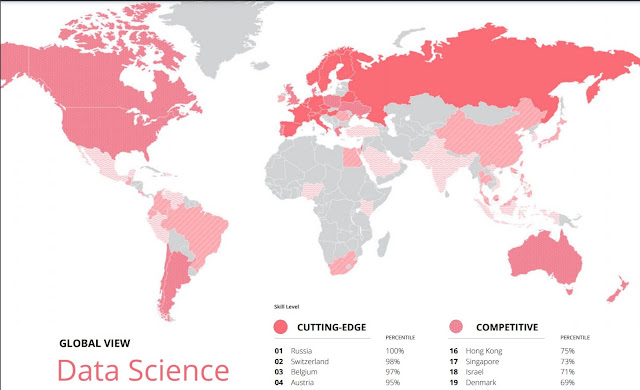
En primer lugar, el el Coursera Global Skills Index 2020 se ofrece un overview a través de un mapa mundi clasificando a los países por su nivel en Business, Technology y Data Science.
La clasificación por países se realiza en estos cuatro grupos:
- Cutting-Edge: Innovador
- Competitive: Competitivo
- Emerging: Lagging
- Lagging: Rezagado


Global Business - Data Science


Como podéis ver España se encuentra en un nivel competitivo en cuanto a negocios y tecnología, mientras que mejora en el ranking cuando se trata de Data Science ya que ocupa el puesto número 12 de Innovadores.
viernes, junio 05, 2020
Conferencia: Innovar sin ser Google - Manual de Innocación (by Alfons Cornella)
A continuación os dejo con una interesante conferencia Meetup realizada por el gran Alfons Cornella y que lleva por tíulo Innovar sin ser Google - Manual de Innocación en el Experience Lab by Imagine.
Alfons Cornella nos explica cómo innovar sin ser Google. Manual de Innovación.
En esta conferencia online Alfons Cornella nos presenta de manera sintética, los principales aprendizajes realizados sobre innovación y sobre lo que podemos esperar en innovación en los próximos años.
Alfons Cornella nos explica cómo innovar sin ser Google. Manual de Innovación.
En esta conferencia online Alfons Cornella nos presenta de manera sintética, los principales aprendizajes realizados sobre innovación y sobre lo que podemos esperar en innovación en los próximos años.
0
comentarios
Etiquetas:
book,
business,
colaborativa,
future,
google,
howto,
recomendacion,
social,
steam,
training,
tv
Etiquetas:
book,
business,
colaborativa,
future,
google,
howto,
recomendacion,
social,
steam,
training,
tv
martes, mayo 05, 2020
TED: Las primeras 20 horas ¿Cómo aprender cualquier cosa? - The first 20 hours ¿how to learn anything? (by Josh Kaufman - TEDxCSU) #aprender #learn #JoshKaufman #TED #TEDxCSU
En el post de hoy os muestro una interesante charla TED de la mano de Josh Kaufman en el evento TED realizado en la Colorado State University (CSU) con el subtítulo Expanding Your Perspectives. La charla llevaba por título "Las primeras 20 horas - ¿Cómo aprender cualquier cosa?"...
The first 20 hours -- how to learn anything | Josh Kaufman | TEDxCSU
Josh Kaufman is the author of the #1 international bestseller, 'The Personal MBA: Master the Art of Business', as well as the upcoming book 'The First 20 Hours: Mastering the Toughest Part of Learning Anything.' Josh specializes in teaching people from all walks of life how to master practical knowledge and skills. In his talk, he shares how having his first child inspired him to approach learning in a whole new way.
In the spirit of ideas worth spreading, TEDx is a program of local, self-organized events that bring people together to share a TED-like experience. At a TEDx event, TEDTalks video and live speakers combine to spark deep discussion and connection in a small group. These local, self-organized events are branded TEDx, where x = independently organized TED event. The TED Conference provides general guidance for the TEDx program, but individual TEDx events are self-organized.* (*Subject to certain rules and regulations)
The first 20 hours -- how to learn anything | Josh Kaufman | TEDxCSU
Josh Kaufman is the author of the #1 international bestseller, 'The Personal MBA: Master the Art of Business', as well as the upcoming book 'The First 20 Hours: Mastering the Toughest Part of Learning Anything.' Josh specializes in teaching people from all walks of life how to master practical knowledge and skills. In his talk, he shares how having his first child inspired him to approach learning in a whole new way.
In the spirit of ideas worth spreading, TEDx is a program of local, self-organized events that bring people together to share a TED-like experience. At a TEDx event, TEDTalks video and live speakers combine to spark deep discussion and connection in a small group. These local, self-organized events are branded TEDx, where x = independently organized TED event. The TED Conference provides general guidance for the TEDx program, but individual TEDx events are self-organized.* (*Subject to certain rules and regulations)
martes, abril 14, 2020
Teach From Home o Enseña desde Casa (by Google & UNESCO)
Los alumnos catalanes empiezan hoy martes 14 de Abril de 2020 el tercer trimestre de forma virtual (el resto de España lo empezó ayer). Pues bien, Google ha ofrecido un interesante toolkit y recomendaciones para que los profesores puedan asumir lo mejor posible este nuevo reto de disrupción digital acelerada debido al COVID19.

En primer lugar algunas recomendaciones de ¿Cómo enseño a distancia mediante videollamadas?

Otra opción es ¿Cómo enseño a distancia sin videollamadas?

Una gran preocupación entre el profesorado es ¿Cómo hago que mis clases sean accesibles para todos?

Y la importante ¿Cómo capto la atención de mis alumnos con las classes a distancia?

Y por último ¿Cómo mantengo el contacto con los demás profesores?

Se trata de Teach From Home o Enseña desde Casa ( https://teachfromhome.google/intl/es/ ) en el que Google junto a la UNESCO han creado un centro online temporal de información y herramientas para ayudar a los profesores durante la crisis del coronavirus COVID-19:

En primer lugar algunas recomendaciones de ¿Cómo enseño a distancia mediante videollamadas?

Otra opción es ¿Cómo enseño a distancia sin videollamadas?

Una gran preocupación entre el profesorado es ¿Cómo hago que mis clases sean accesibles para todos?

Y la importante ¿Cómo capto la atención de mis alumnos con las classes a distancia?

Y por último ¿Cómo mantengo el contacto con los demás profesores?

jueves, noviembre 14, 2019
6 Conceptos de comunicación que impulsan la Comprensión
Vía el artículo titulado 6 Communication Concepts That Boost Understanding (by Alina en UserLike.com) os muestro a continuación los 6 conceptos de comunicación que impulsan la comprensión.
6 conceptos de comunicación que impulsan la comprensión
1. El principio del Iceberg - The Iceberg Principle
2. El Sesgo de Negatividad - The Negativity Bias
3. Fluidez de preocesamiento - Processing Fluency
4. Las 7 Cs de la Comunicación - The 7 Cs of Communication
5. No cumplir expectativas - Expectancy Violation
6. Disonancia cognitiva - Cognitive Dissonance
6 conceptos de comunicación que impulsan la comprensión
1. El principio del Iceberg - The Iceberg Principle
2. El Sesgo de Negatividad - The Negativity Bias
3. Fluidez de preocesamiento - Processing Fluency
4. Las 7 Cs de la Comunicación - The 7 Cs of Communication
5. No cumplir expectativas - Expectancy Violation
6. Disonancia cognitiva - Cognitive Dissonance
jueves, octubre 17, 2019
Vídeo: Evolución Lenguajes programación 1965 - 2019 (by Data Is Beautiful)
A continuación un interesante gráfico en movimiento en el que se puede ver cómo han ido cambiando las preferencias en los lenguajes de programación a nivel mundial en los últimos 55 años...
Most Popular Programming Languages 1965 - 2019 (by Data Is Beautiful)
Timeline of the most popular programming languages since 1965 to 2019. So far the most intense ranking I've ever done :) For recent years I've used multiple programming languages popularity indexes with adjustments thanks to the data from GitHub repositories access frequency. For historical ranking I've used aggregation of multiple national surveys to establish several data points, plus a world wide publications rate of occurrence. In this ranking popularity is defined by percentage of programmers with either proficiency in specific language or currently learning/mastering one. Y axis a relative value to define ranking popularity between all other items.
Most Popular Programming Languages 1965 - 2019 (by Data Is Beautiful)
Timeline of the most popular programming languages since 1965 to 2019. So far the most intense ranking I've ever done :) For recent years I've used multiple programming languages popularity indexes with adjustments thanks to the data from GitHub repositories access frequency. For historical ranking I've used aggregation of multiple national surveys to establish several data points, plus a world wide publications rate of occurrence. In this ranking popularity is defined by percentage of programmers with either proficiency in specific language or currently learning/mastering one. Y axis a relative value to define ranking popularity between all other items.
Suscribirse a:
Entradas (Atom)